Panel discusses how to handle sexist creeps in language
By Mia Chism
PORTLAND, Oregon — Why do we use terms such as “male nurse,” “lady doctor” and “male prostitute”? Why is there a need to clarify gender when it comes to these roles and occupations, as if there are gender-based stigmas associated with them?
Or the better question is: How do we, as copy editors, catch and fix this sexist language when it comes across in our daily work in the 21st century?
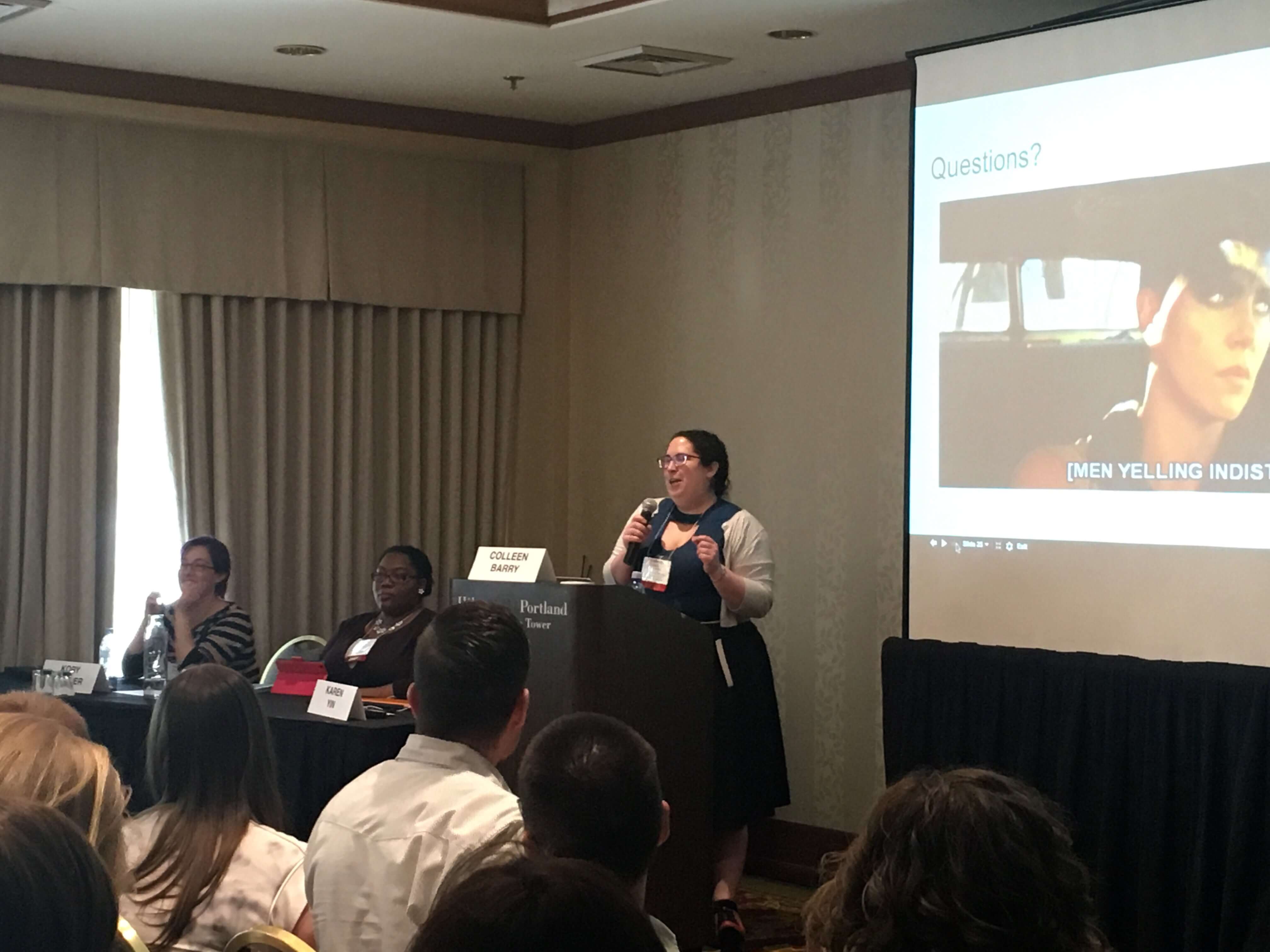
A four-member panel discussed specific topics on sexist language and how to handle it during the one-hour session Friday afternoon. The panel consisted of Colleen Barry, freelance journalist; Dilane Mitchell, ad representative, Tribune Publishing; Kory Stamper, associate editor, Merriam-Webster; and Karen Yin, freelancer, AP vs. Chicago | Conscious Style Guide.
Barry started the session by discussing what sexism is … and what it isn’t.
“Sexism is gender-based prejudice plus power,” she said. “So just saying something nasty about a gender is not itself sexism, there has to also be institutional or societal power behind it, which is why saying ‘old men are dicks,’” is not sexist. She added that sexism, though, hurts people of all genders.
Barry passed the discussion to Yin, who discussed how the Associated Press Stylebook and the Chicago Manual of Style address language that could be considered sexist.
“AP style totally favors expressions and popular usage,” she said, noting that that is how email lost its hyphen. “I see their efforts in trying to acknowledge nontraditional thoughts and different points of view,” she said. “But at the same time it doesn’t seem to really comprehend what’s going on.”
Yin continued her discussion by reading terms from the Associated Press Stylebook — same sex marriage, gay marriage, widow/widower, female/woman — that were contradictory regarding the roles and importance of males and females. She read an entry: “Although the word ‘humanity’ is the best choice for when both men and women are involved, (the words) ‘man’ and ‘mankind’ can be used if no other term is convenient.”
Yin said, “So, I hear, ‘Oh, if being nonsexist is not convenient, then don’t worry about it, you know, next time — you’ll get it.’”
One of the main points of this session was to educate the audience on what kind of sexist terminology is being used on a daily basis and to not be complacent and not let it go, but to speak up, stand up and talk to someone about why sexist language should be replaced or deleted entirely. Note: Maybe don’t use AP style as your only reference guide regarding sexist language.
How to be a pain in the ass without getting fired (from the session’s PowerPoint narrated by Colleen Barry, freelance journalist):
- Start with a questions
- Keep criticism specific to the text, not the person
- Really listen to the response
- Propose a solution (or several solutions)
- Push past the first ‘no’
- If you get a second ‘no’, either
- Bow out gracefully
- Appeal to a higher authority or
- Thank them for their willingness to discuss the issue.
Top 9 takeaways:
- Associated Press stylebook is for newspapers, Chicago Manual of Style is for books. (PowerPoint)
- Using the terminology ‘opposite sex’ is extremely damaging for everyone. — Karen Yin, freelancer, AP vs. Chicago | Conscious Style Guide.
- Instead of using the word ‘man-made,’ change it to be inclusive by replacing it with ‘synthetic,” or reword the sentence. —Yin
- Don’t use the word “lady” as a modifier. — Kory Stamper, associate editor, Merriam-Webster
- Article titles that somewhat resemble “Why are there so many tough guys who sound like ladies on the radio?” are not helping ladies or men or anyone in between. —Stamper
- The “delete” key is your friend. — Colleen Barry, freelance journalist
- Speak up. You have to try to fight for deleting the sexist language in stories you read and/or edit. You won’t win every fight, though. — Barry
- The term “feminism” is different for people or color, queer, and both of those things. — Dilane Mitchell, ad representative, Tribune Publishing
- The language is influx. The problem with gender is that we focus on specific words that we somehow can miss the surrounding connotations around them. — Stamper
ACES newsroom member Mia Chism is a student at the University of Oklahoma.