Ways words get made
By Emily Brewster
A dive into the various origin stories of the members of the English lexicon is best preceded by a quick swim in the details of the language’s basic composition. The heart of the language is Germanic, thanks to some fifth and sixth century invaders, and a huge number of its words are Latinate, thanks especially to the 1066 invasion of French-speaking Normans. Unlike many of its Indo-European relations, English has over the years winnowed away most of its inflections and abandoned grammatical gender, making modification of its own words and adoption of foreign words very easy to do.
A slew of words were adopted in the wake of that 11th century Norman invasion, though as the word invasion implies, the influx wasn’t by invitation. The Normans imposed French words on a language that already had 500 years under its belt, resulting in many pairs of roughly synonymous terms. English had dwell but got reside; think was joined by conceive, offspring by progeny. In each case, the prestige French enjoyed had lasting semantic effect, with the Latinate word tending to be somewhat elevated.
English has more willingly borrowed words in the years since, such as karaoke from Japanese and shampoo from Hindi and Urdu. Greek and Latin, both mined actively for words since the Renaissance, continue to be the source of new English words. Aquafaba, for example, was coined in 2015 to refer to the liquid that results when beans are cooked in water — a popular egg white substitute. Even such a modern-sounding word as locavore is indebted to the ancients: its origin lies in Latin locus, meaning “place,” and vorare, meaning “to devour.”
Of course, a locavore isn’t someone who devours places. Locavore is also an example of a very modern way English words get made: it’s a blending together of the word local and the -vore of carnivore. The first English blends, also called portmanteaus (thanks to Lewis Carroll), date to the late 16th century, but coinage by blending didn’t really catch on till the 19th century, when the likes of brunch and smog arrived. We live today in a kind of golden age of blends, with hangry, chillax, and athleisure settling easily into the lexicon and many others trying to elbow their way in.
Sometimes a new word is made by simply clipping back an existing one. Pants is an early 19th century shortening of pantaloons; the “perks” of a job were “perquisites” until about the same time. Words aren’t always clipped in a way that respects etymology: in the process known as “metanalysis,” or “false division,” a language’s speakers misunderstand where one word ends and another begins. Before a cook donned “an apron,” the protective garment tied about one was “a napron.”
Some words have their origin in “folk etymology,” whereby a word is modified to be something more familiar or logical. While a hangnail is a bit of skin hanging loose at the side or root of a nail, its older form is the Old English word angnægl, meaning “corn on the foot.” The ang part means “painful,” but with that information lost over time, English speakers thought hang made more sense.
Also logical is the creation of words by way of back-formation: a real (or supposed) affix is dropped from an existing word to make a related word. Blame back-formation for many words people love to hate, such as surveil, commentate, escalate, and burgle. But also note that it’s responsible for donate, homesick, and edit too.
Sometimes word creation occurs through the modification of a phrase. The adjective pitch-black comes by way of phrasal abridgment from “black as pitch.” A killjoy is one who kills the joy of others; the color known as sky blue is the blue color of the sky. Asshat effectively evokes the obtuseness of one who has mistaken their posterior for a hat.
And then there are words into which considerably less thought has been put. The Merriam-Webster Unabridged dictionary includes almost 800 words that have as some part of their genesis the imitation of a sound. In lexicography we say these words are “imitative” in origin; in poetry the technique is called onomatopoeia — that is, using words that sound like what they mean, such as plop, gurgle, zoom, zing, hiccup. Many of these terms seem especially well-suited for comic books but there are technical terms among the ranks of the imitative-in-origin bunch: in the working vocabulary mostly only of gastroenterologists, borborygmus refers to intestinal rumbling caused by moving gas. It’s ultimately from the Greek word borboryzein, a word formed to imitate the rumble it names.
When a word suits up as an entirely other part of speech the resulting word exists thanks to what we call “functional shift.” While the verb gift may irk many people who think gift is best arrayed in nounal garb, our vocabulary would be seriously stunted if we insisted that words remain confined to their original parts of speech. There would, for example, be no sweets, only sweet things: the adjective sweet predates the noun by more than 500 years. Perhaps we’ll all adjust to adulting eventually as well.
There are more ways words get made than those described here. The average user of a language can get by perfectly well in full ignorance of all of them. But for those whose work involves words, knowing how the words came to be is a pleasure that can illuminate the work they do.
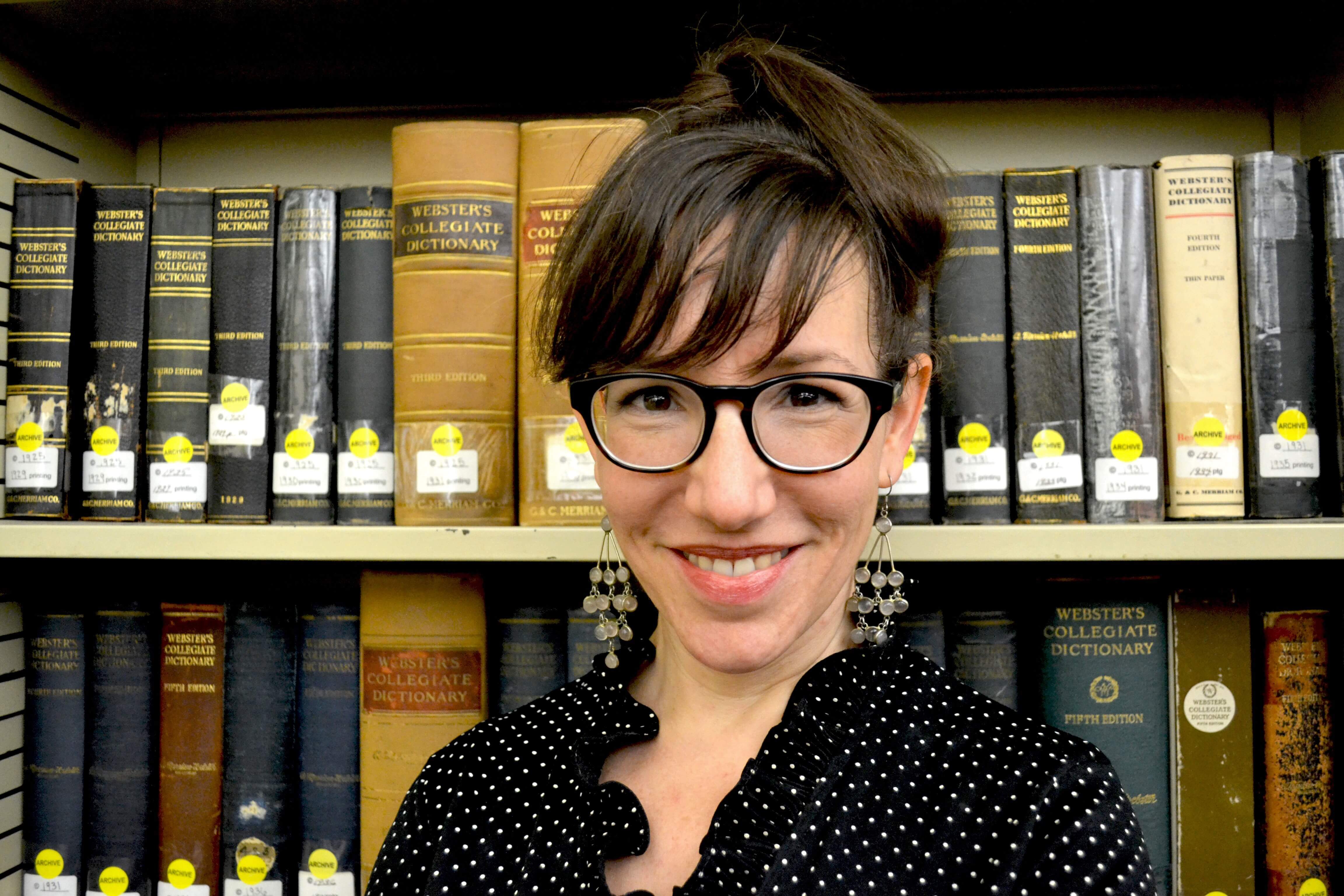
Emily Brewster is an Associate Editor and lexicographer at Merriam-Webster. In addition to defining, she writes regularly about grammar, usage, and language change at Merriam-Webster.com, and speaks to audiences about lexicography and language generally.
Photo by Waldemar Brandt on Unsplash