Skip to content

Confusables: Insidious and invidious

By Andy Hollandbeck

There’s a lot of negativity in the press these days. Regardless of our political and ethical beliefs, we copy editors are charged with making sure that negativity is expressed properly, so it’s a good idea to make sure you understand two very negative words that can easily be confused because they differ by a single letter: insidious and invidious.

Insidious comes from the Latin insidiosus “ambush,” from in- + sedēre “to sit,” and its earliest meaning was ambush-like: “awaiting the opportunity to entrap.” Today, it generally means “having a gradual and cumulative negative effect” (notice that’s an and and not an or in there).

Of a disease, insidious describes an affliction that develops so gradually as to be well-established by the time it’s even noticed. A tapeworm is a good example of an insidious parasite. But this sense of subtle degradation can apply to humans, too: A person described as insidious works subtly and secretly so as not to draw suspicion.

Some of you are having a Star Wars a-ha! moment right about now. “A-ha!” you exclaim. “Darth Sidious was actually Chancellor Palpatine, who worked subtly and secretly (and also gradually) to undermine the democracy of the Galactic Republic. So that’s how they got the name!”

Yes. And it’s also a great mnemonic device for remembering what insidious means.

Invidious differs from insidious by a single letter, and as it happens, the same applies in part to its etymological source. It comes from the Latin invidiosus “envious,” from invidia “envy.” (That might make you wonder about the technology company Nvidia.) The word has been used as a synonym for envious, but when you see invidious used today, that probably isn’t what it means.

Invidious means “of an unpleasant or objectionable nature” (i.e., obnoxious) or “of a kind to cause resentment or harm” (i.e., noxious). Other synonyms include pernicious and repugnant. Since invidious is a more general term for something undesired than insidious is, it seems reasonable that invidious would be the more common term, but that doesn’t appear to be the case. Both words, though, are on the decline.

Keeping these two words straight can be difficult because a) they look and sound so similar; b) they’re both negative; and c) something that is one can also be the other. Take, as an example, a computer virus. It’s insidious because it works subtly from within your computer to destroy your files, and by the time you know it’s there, it has already taken over. And it’s invidious both because it’s so objectionable and because it causes harm.

However, in Garner’s Modern American Usage, Third Edition, Bryan Garner warns, “The two words generally ought not to be used in the same sentence because sound might appear to triumph over sense.”

Your mileage may vary.

Header photo via Jason Hafso, Unsplash.

This article was originally posted on the Copyediting website, Aug. 2, 2017.

How to convince your boss to send you to an ACES conference

Aug 26, 2026

You know an ACES conference can leave you with new ideas, stronger skills, and fresh approaches to your work. But getting your boss to approve the investment may require showing how attending can benefit not only you but also your organization.

Read More

A new year for ACES: Reflections and what’s ahead

Jul 16, 2026

A new fiscal year is always a good moment to pause, look back at what we’ve built together, and look forward to what’s coming next. There’s a lot to say on both counts.

Read More

Words, people, and the privilege of serving ACES

Jul 16, 2026

I’ve told the story of my first ACES conference many, many times. Partially because it’s such a fond personal memory, but mostly because it shows how ACES brings editors together and helps them feel like they belong.

Read More

These are my people: Reflections on 30 years of ACES

Jul 8, 2026

ACES had been around for nine years when I first attended a national conference, in Cleveland. What I knew right away (and this has been said many times before) was that these are my people: people who care about the written word, people who care about getting it right for their readers, people who care about their craft and care about how their colleagues are contributing to the common goal of clarity.

Read More

Neil Holdway: A Legacy of Service to ACES

Apr 25, 2026

Neil Holdway has been part of the ACES Board for more than 20 years.

He joined in 2005 and served as treasurer, secretary, vice president, and treasurer of the ACES Education Fund. He was also the president of the ACES Board.

Read More

Nadia Geagea Pupa Wins the 2026 Robinson Prize, the Industry’s Highest Honor

Apr 25, 2026

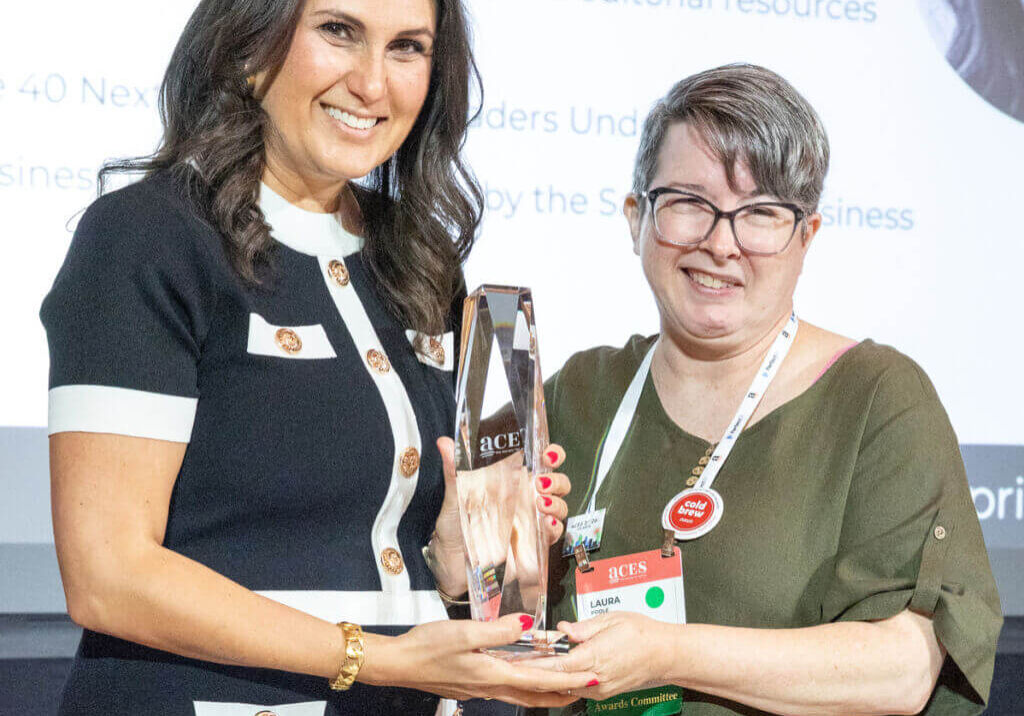
ACES: The Society for Editing has awarded its 2026 Robinson Prize to Nadia Geagea Pupa.

Read More

Gerri Berendzen named ACES’ 2026 Glamann Award winner

Apr 25, 2026

The Board of Directors of ACES has awarded its 2026 Glamann Award to former ACES Board member and longtime news editor and teacher Gerri Berendzen.

Read More

AP announces stylebook changes; “healthcare” tops list

Apr 24, 2026

Big reveal at the ACES conference in Atlanta: AP Stylebook editor Bratton announced that “healthcare” will now be one word

Read More

2026 Bill Walsh Scholarship goes to two winners

Feb 9, 2026

By ACES Staff The ACES Education Fund has chosen two winners for the 2026 Bill Walsh Scholarship for excellence in the editing of news. Abbey Sobelman and Sheridan Wood are the tenth and eleventh recipients of the $3,500 award, named for the late Washington Post editor and author Bill Walsh, who also was a member…

Read More

2025-2026 ACES scholarship and Aubespin winners

Feb 9, 2026

By ACES Staff Two students from The George Washington University’s Master of Professional Studies in publishing program are among the five winners of 2025-2026 ACES scholarships by the ACES Education Fund, including this year’s Aubespin Scholar. The recipients will receive a total of $8,500 in scholarships. The scholarships are given to students who excel in…

Read More
Scroll To Top