Skip to content

A machete or a razor?

By Craig Clarke

Good editing is invisible. Bad editing is painfully obvious—usually because the editor has, instead of clarifying the author’s intent, attempted to rewrite in the editor’s own style. Editors are there to remove, rearrange, and altogether improve, not to make the writing their own.

To illustrate this idea, I will take a piece of writing often mocked as purple prose and use both approaches. One hopes the author, long dead, will take no more offense at this than at having inspired both a contest for atrocious writing and a beloved cartoon beagle’s creative pursuits.

It was a dark and stormy night; the rain fell in torrents—except at occasional intervals, when it was checked by a violent gust of wind which swept up the streets (for it is in London that our scene lies), rattling along the house-tops, and fiercely agitating the scanty flame of the lamps that struggled against the darkness.

This is the first sentence of Edward Bulwer-Lytton’s novel Paul Clifford. Let’s agree that, while the language is evocative, the sentence itself is in dire need of assistance.

There are two ways to approach this task. The first approach is to completely rewrite the sentence so that it says the same thing but differently. Let’s call this “The Machete Approach” since it involves the near complete deconstruction of the original, and its subsequent reassembly from scratch.
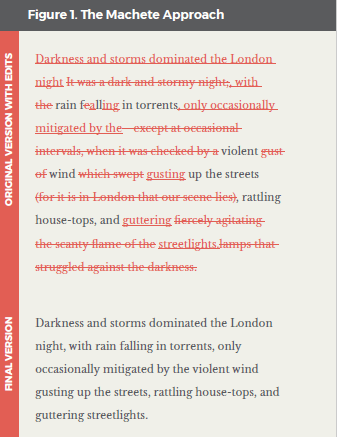
The original contains 58 words. The Machete Approach more than halves that total to 28. The result seems familiar but in no way resembles the original. In fact, it reads much more like I wrote it than Bulwer-Lytton.

The better approach is to gently improve the flow and clarity while retaining the author’s voice. Let’s call this “The Razor Approach,” since it involves paring extraneous words and phrases while retaining the author’s distinctive voice and style.
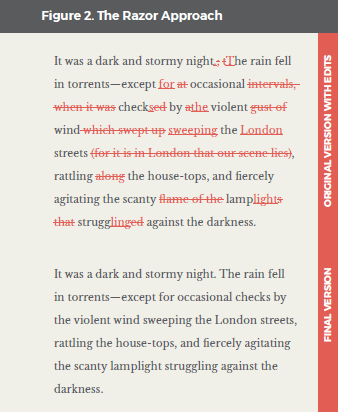
This second approach is gentler than the first, preserving more of the original word order and choice while still streamlining the content and lowering the word count to 37. More work could still be done, but that begins to encroach on the author’s domain.

Beginning editors sometimes forget that, in the end, it is the author’s name that goes on the work. I’ve learned to think of my edits as suggestions—especially since the writer is not obliged to accept them—so as to not take any rejections personally. (After all, it is the author’s prerogative to be wrong.)

Sometimes, rewriting is necessary. When this is the case, offer recommendations for improvements but leave the changes to the writer. An editor who spends more time with a machete than a razor needs to find some other creative expression than chopping up someone else’s brainchild . . . such as writing an article about editing, perhaps?

A Machete or a Razor? was originally published in Tracking Changes (Summer 2020 edition). Members receive a PDF of the quarterly Tracking Changes newsletter by email.

Header photo by Aaron Burden on Unsplash.

How to convince your boss to send you to an ACES conference

Aug 26, 2026

You know an ACES conference can leave you with new ideas, stronger skills, and fresh approaches to your work. But getting your boss to approve the investment may require showing how attending can benefit not only you but also your organization.

Read More

A new year for ACES: Reflections and what’s ahead

Jul 16, 2026

A new fiscal year is always a good moment to pause, look back at what we’ve built together, and look forward to what’s coming next. There’s a lot to say on both counts.

Read More

Words, people, and the privilege of serving ACES

Jul 16, 2026

I’ve told the story of my first ACES conference many, many times. Partially because it’s such a fond personal memory, but mostly because it shows how ACES brings editors together and helps them feel like they belong.

Read More

These are my people: Reflections on 30 years of ACES

Jul 8, 2026

ACES had been around for nine years when I first attended a national conference, in Cleveland. What I knew right away (and this has been said many times before) was that these are my people: people who care about the written word, people who care about getting it right for their readers, people who care about their craft and care about how their colleagues are contributing to the common goal of clarity.

Read More

Neil Holdway: A Legacy of Service to ACES

Apr 25, 2026

Neil Holdway has been part of the ACES Board for more than 20 years.

He joined in 2005 and served as treasurer, secretary, vice president, and treasurer of the ACES Education Fund. He was also the president of the ACES Board.

Read More

Nadia Geagea Pupa Wins the 2026 Robinson Prize, the Industry’s Highest Honor

Apr 25, 2026

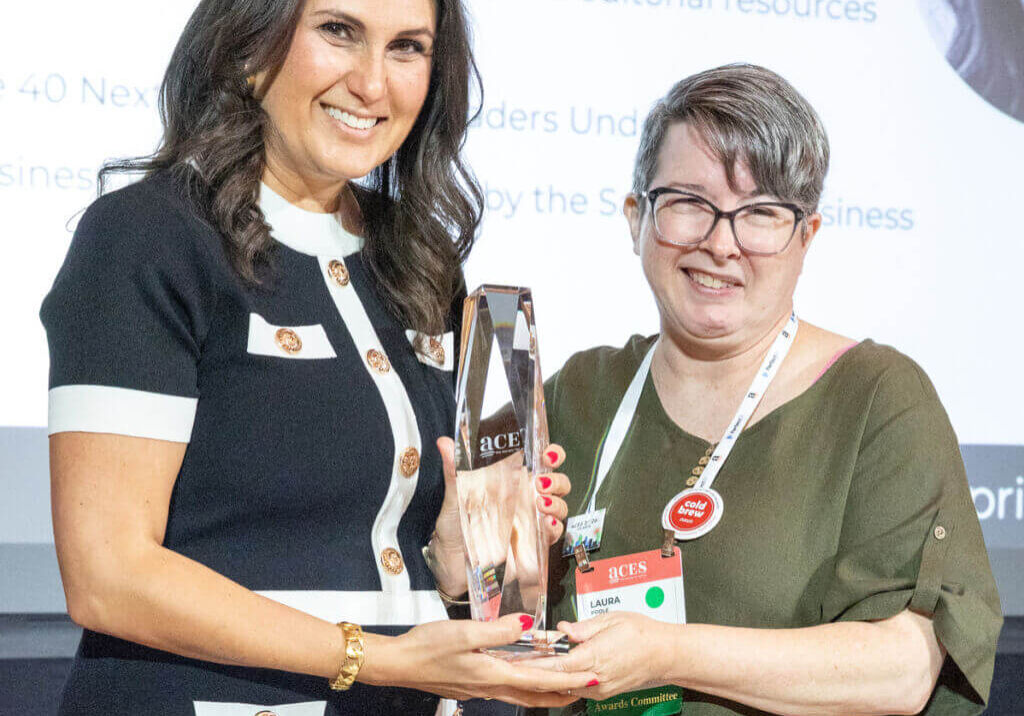
ACES: The Society for Editing has awarded its 2026 Robinson Prize to Nadia Geagea Pupa.

Read More

Gerri Berendzen named ACES’ 2026 Glamann Award winner

Apr 25, 2026

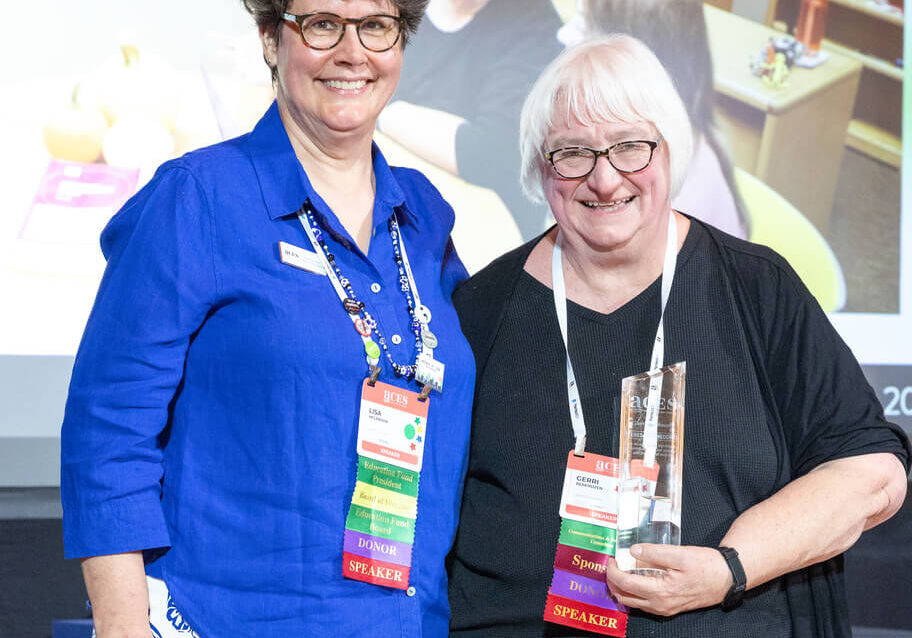
The Board of Directors of ACES has awarded its 2026 Glamann Award to former ACES Board member and longtime news editor and teacher Gerri Berendzen.

Read More

AP announces stylebook changes; “healthcare” tops list

Apr 24, 2026

Big reveal at the ACES conference in Atlanta: AP Stylebook editor Bratton announced that “healthcare” will now be one word

Read More

2026 Bill Walsh Scholarship goes to two winners

Feb 9, 2026

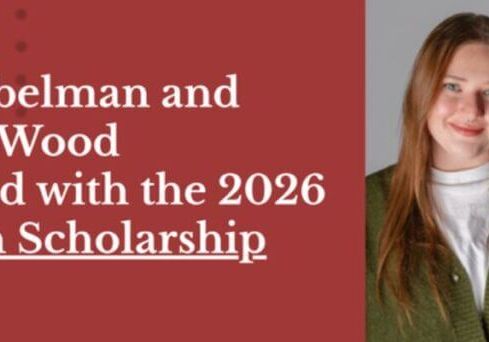
By ACES Staff The ACES Education Fund has chosen two winners for the 2026 Bill Walsh Scholarship for excellence in the editing of news. Abbey Sobelman and Sheridan Wood are the tenth and eleventh recipients of the $3,500 award, named for the late Washington Post editor and author Bill Walsh, who also was a member…

Read More

2025-2026 ACES scholarship and Aubespin winners

Feb 9, 2026

By ACES Staff Two students from The George Washington University’s Master of Professional Studies in publishing program are among the five winners of 2025-2026 ACES scholarships by the ACES Education Fund, including this year’s Aubespin Scholar. The recipients will receive a total of $8,500 in scholarships. The scholarships are given to students who excel in…

Read More
Scroll To Top