Jargon or plain language?
By Eloise DeHaan
Every copyediting field has its own special words. My field is medical copyediting, and I edit reports about healthcare that are written in an academic style featuring many clinical terms.
I watch out for special typos as I edit reports about new medical treatments. A drug regimen can be transformed into a regime. Causal, meaning a cause-and-effect relationship, can be mistyped as casual. And in spite of using a medical spellchecker, I still know that Filibration is a German disc jockey, while fibrillation is something that happens to the heart.
The reports are an important part of the PCORI (Patient-Centered Outcomes Research Institute) Health Care Horizon Scanning System. The system searches (scans the horizon) for new treatments that could disrupt US healthcare. ECRI, my employer, runs the horizon scans for PCORI.
I also obtain reviews of these reports about new medical treatments from our 430 reviewers. Some are busy doctors who are leaders in their fields; others are patients who want to learn more. They rate the likelihood that a treatment, as described in the report, will disrupt US healthcare. These reviewers are our target readers, and we must write in such a way that they understand the content without struggling through the words.
Your reader
Medical publications target readers of varying backgrounds. And the words used differ according to the audience.
Consider a brochure about chronic T-cell lymphoma written for patients in a doctor’s office. A patient might read at a grammar-school level. So, a medical copyeditor working on the brochure would expect to see the medical words chronic and lymphoma joined by the easier-to-understand equivalents ongoing and blood cancer. Sentences would be simple in structure, presenting only one or two ideas.
In contrast, an article about chronic T-cell lymphoma for the journal Cell would be written for a reader with an advanced education. Using specialized medical words would be OK. A medical copyeditor would understand the word smoothened as the name of a protein that takes part in the hedgehog signaling pathway, which is the name of a molecular communication system in the body that, if disrupted, can cause blood cancer. Compound sentences are commonly used. Some sentences present statistics that need to be copyedited by someone with medical-terminology expertise.
Plain language
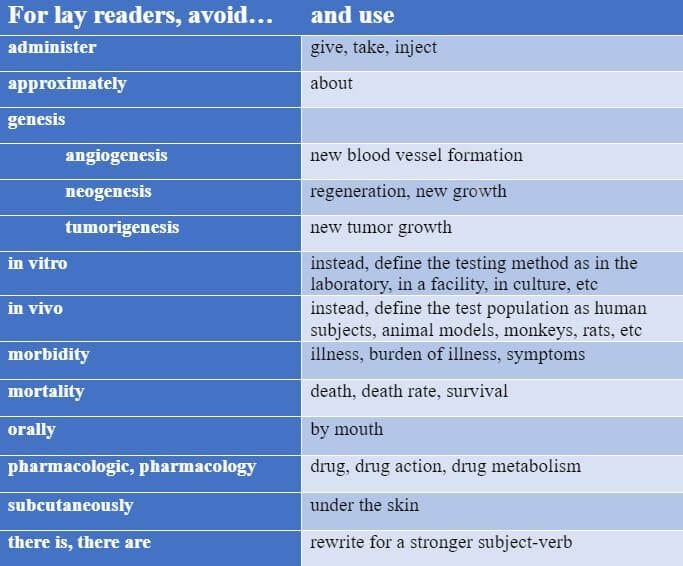
For lay readers, some medical text can be edited for readability. A multisyllabic word thicket can be tidied up by substituting shorter words. A nurse who administers a vaccine can as easily give it. Some medical terms are jargon and can be changed to words that are readily understood, such as angiogenesis becoming new blood vessel growth, an edit that might need an author query to approve.
Groups, including the federal government, advocate writing with readily understood words, a strategy called plain language in the United States. In September 2020, I created a plain language list for the horizon scanning analysts (who are our writers). Editors in other fields can create similar lists to be sure all target readers are reached.
My list will grow as the changes become second nature for our writers. Sadly, it won’t have one entry I love for its earthiness (from the plain language thesaurus provided by the Centers for Disease Control and Prevention) but cannot recommend for our target audience: instead of urinate, use pee.
Words to change for lay readers
Jargon or plain language? was originally published in Tracking Changes (Summer 2021 edition). Members receive a PDF of the quarterly Tracking Changes newsletter by email.
Header image by Bruno Martins on Unsplash