Skip to content

Dealing with religious terms: One faith

By Erin Brenner

In the EAE Backroom an editor asked a question on styling a religious term: “Who would capitalize ‘holy family’ in Chicago style?”

The ensuing conversation brought to light some issues concerning religious terminology:

  • Our main stylebooks, such as Chicago and AP, offer guidance that is sometimes vague or meant for publications that target general audiences.
  • A general audience can include people of many religions, as well as those of no religion. At least in US English, there can be a bias toward Christianity that leaves many feeling confused or excluded.
  • The approach to a text meant for a particular religion should be different from an approach to a text meant for a wider audience.

How can editors resolve these issues? Start by determining whether the audience is of one religion or a mix (or no religion). This article looks at a target audience of one faith.

WHEN YOUR AUDIENCE IS OF ONE FAITH

When the text is aimed at people of a specific religion, you’ll want to respect the traditions and beliefs associated with that religion. While the assigned dictionary and a mainstream style guide can help, you’ll want to look at resources focused on that religion.

Consider, too, whether you’re dealing with a specific sect, or denomination, of that religion. For example, while Christianity is thought of as a whole (and once was), there are many belief systems within it. Catholicism is distinct from Calvinism and Lutheranism. And even within Catholicism, there are divisions between Roman (those we typically think of as “Catholic”) and Eastern (e.g., Greek and Armenian).

Each of these religions could treat terms differently based on what they see as holy or on traditions that have developed over the years.

Other major world religions, such as Islam and Judaism, also have different denominations within them. Islam includes Sunni Islam, Shia Islam, and Kharijites, as well as several schools of theology and jurisprudence. Judaism includes Orthodox, Conservative, Reconstructionist, and Reform denominations.

And those are just the main monotheistic religions!

Once you’ve determined your audience, seek out resources that cover terminology meaning and usage. What follows is just a sampling.

Christianity

Roman Catholicism

Islam

Judaism

This article was originally posted to Copyediting.com on 10/19/18.

Header photo by Rachel Strong on Unsplash.

How to convince your boss to send you to an ACES conference

Aug 26, 2026

You know an ACES conference can leave you with new ideas, stronger skills, and fresh approaches to your work. But getting your boss to approve the investment may require showing how attending can benefit not only you but also your organization.

Read More

A new year for ACES: Reflections and what’s ahead

Jul 16, 2026

A new fiscal year is always a good moment to pause, look back at what we’ve built together, and look forward to what’s coming next. There’s a lot to say on both counts.

Read More

Words, people, and the privilege of serving ACES

Jul 16, 2026

I’ve told the story of my first ACES conference many, many times. Partially because it’s such a fond personal memory, but mostly because it shows how ACES brings editors together and helps them feel like they belong.

Read More

These are my people: Reflections on 30 years of ACES

Jul 8, 2026

ACES had been around for nine years when I first attended a national conference, in Cleveland. What I knew right away (and this has been said many times before) was that these are my people: people who care about the written word, people who care about getting it right for their readers, people who care about their craft and care about how their colleagues are contributing to the common goal of clarity.

Read More

Neil Holdway: A Legacy of Service to ACES

Apr 25, 2026

Neil Holdway has been part of the ACES Board for more than 20 years.

He joined in 2005 and served as treasurer, secretary, vice president, and treasurer of the ACES Education Fund. He was also the president of the ACES Board.

Read More

Nadia Geagea Pupa Wins the 2026 Robinson Prize, the Industry’s Highest Honor

Apr 25, 2026

ACES: The Society for Editing has awarded its 2026 Robinson Prize to Nadia Geagea Pupa.

Read More

Gerri Berendzen named ACES’ 2026 Glamann Award winner

Apr 25, 2026

The Board of Directors of ACES has awarded its 2026 Glamann Award to former ACES Board member and longtime news editor and teacher Gerri Berendzen.

Read More

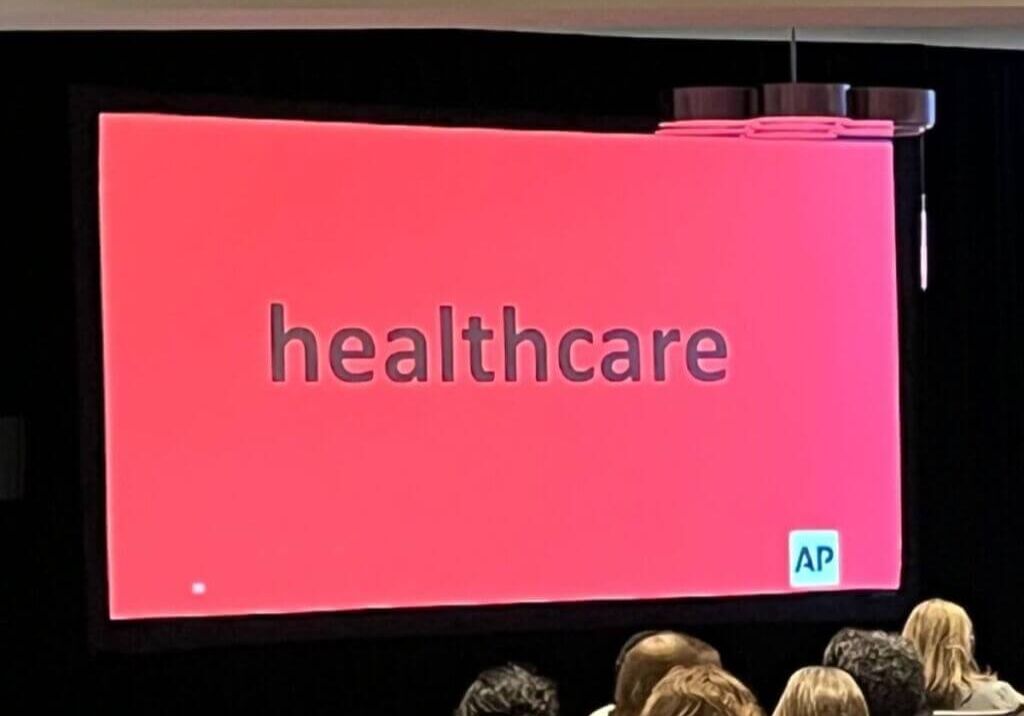
AP announces stylebook changes; “healthcare” tops list

Apr 24, 2026

Big reveal at the ACES conference in Atlanta: AP Stylebook editor Bratton announced that “healthcare” will now be one word

Read More

2026 Bill Walsh Scholarship goes to two winners

Feb 9, 2026

By ACES Staff The ACES Education Fund has chosen two winners for the 2026 Bill Walsh Scholarship for excellence in the editing of news. Abbey Sobelman and Sheridan Wood are the tenth and eleventh recipients of the $3,500 award, named for the late Washington Post editor and author Bill Walsh, who also was a member…

Read More

2025-2026 ACES scholarship and Aubespin winners

Feb 9, 2026

By ACES Staff Two students from The George Washington University’s Master of Professional Studies in publishing program are among the five winners of 2025-2026 ACES scholarships by the ACES Education Fund, including this year’s Aubespin Scholar. The recipients will receive a total of $8,500 in scholarships. The scholarships are given to students who excel in…

Read More
Scroll To Top