ACES Gets a Peek Behind the AP Stylebook Curtain
By Gerri Berendzen, ACES Publications and Communications Committee
What goes into the decision-making process at the Associate Press Stylebook?
A audience of a couple of hundred people at ACES 2025, ACES’ 29th annual conference, got to peek behind the curtains a bit Friday morning in Salt Lake City when the AP team presented “AP Stylebook: What’s New, Plus Style and You.”
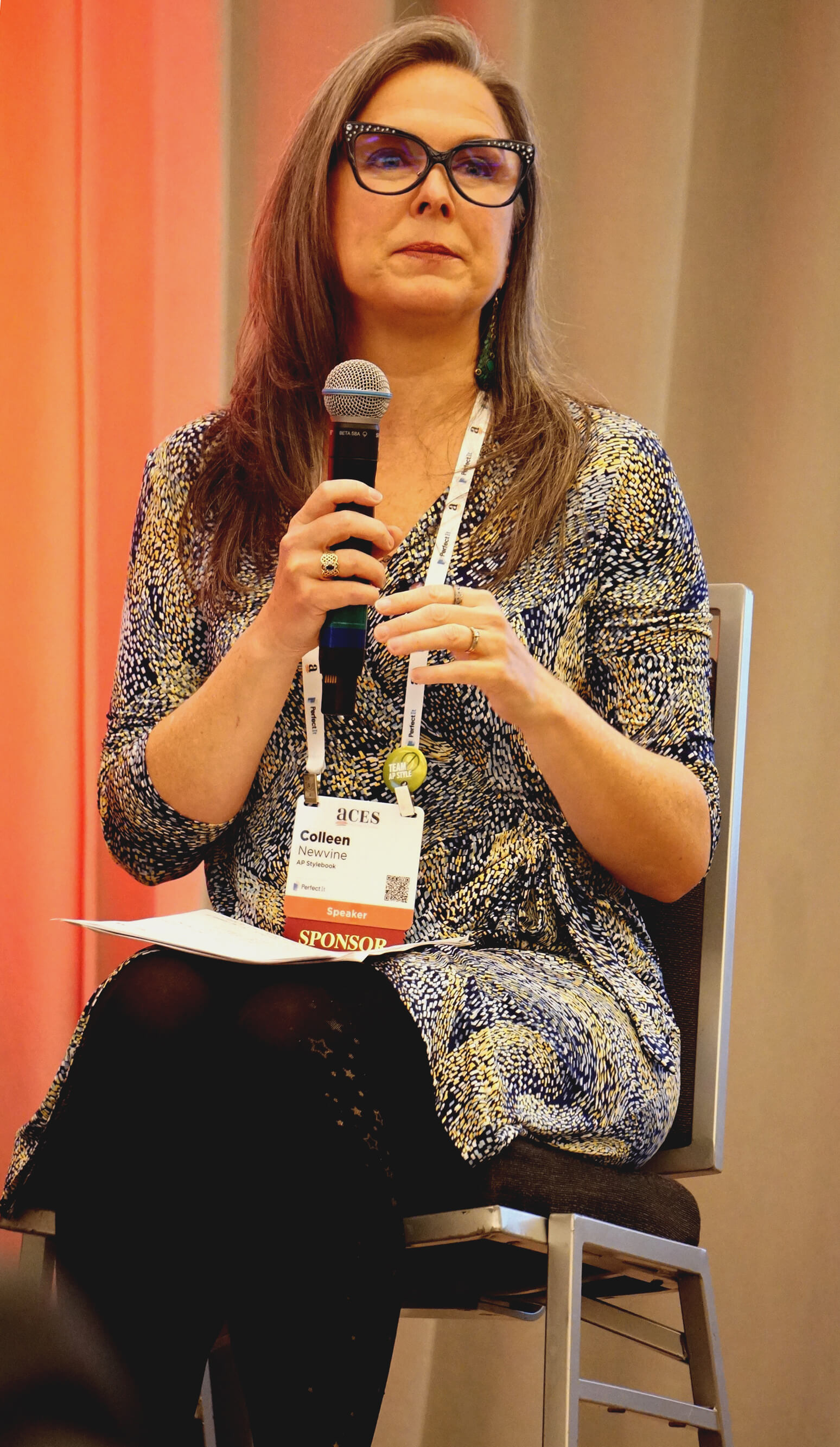
Three members of the AP Stylebook team gave an update on what’s going on with the stylebook by holding a bit of a fireside chat (without the fire) to explain the stylebook process.
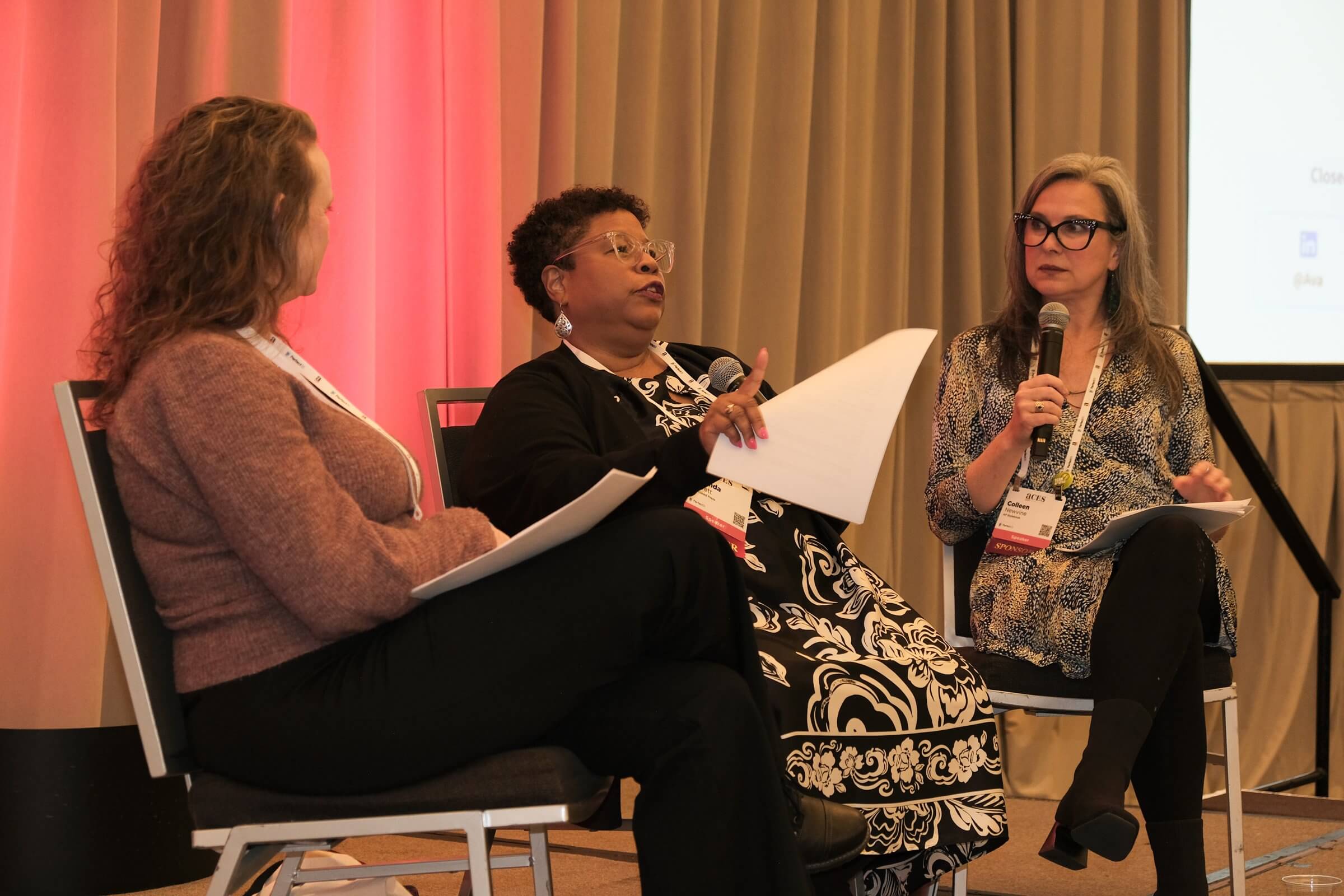
Colleen Newvine, product manager for the AP Stylebook, served as moderator while Amanda Barrett, AP vice president of news, standards and inclusion, and Anna Jo Bratton, AP enterprise editor, talked about the process and fielded questions.
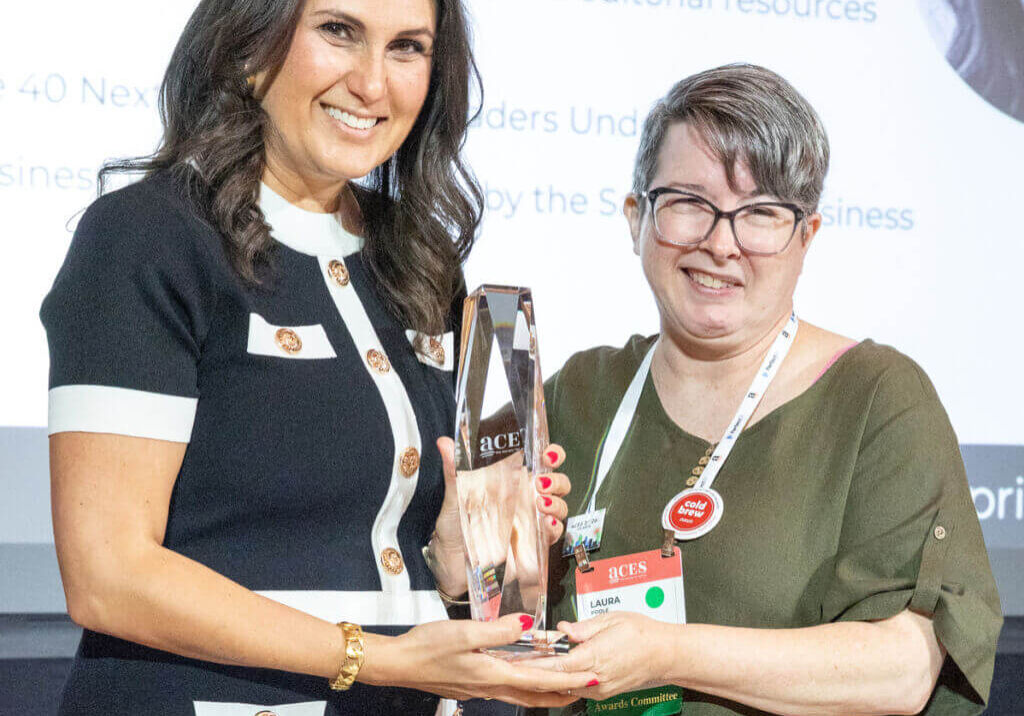
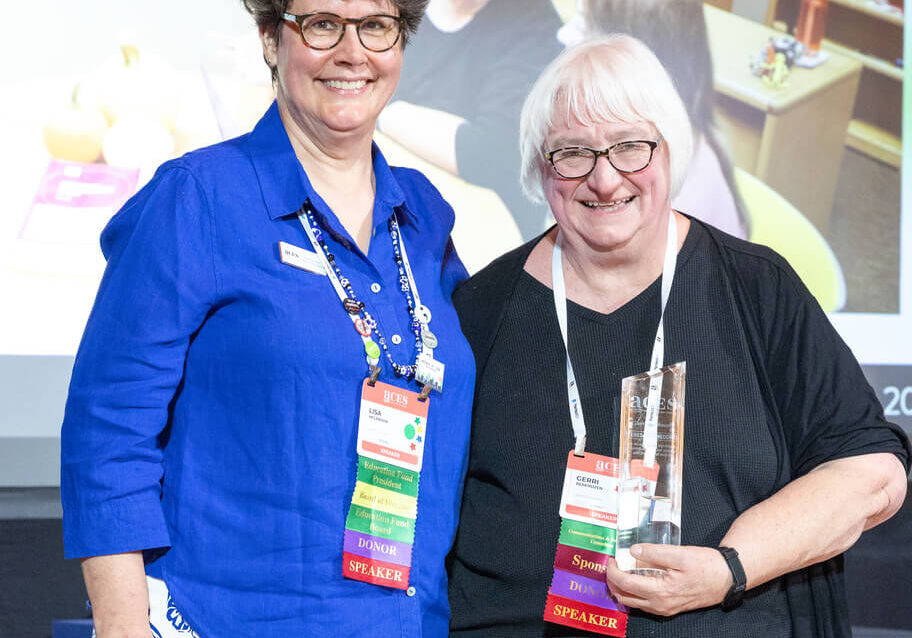
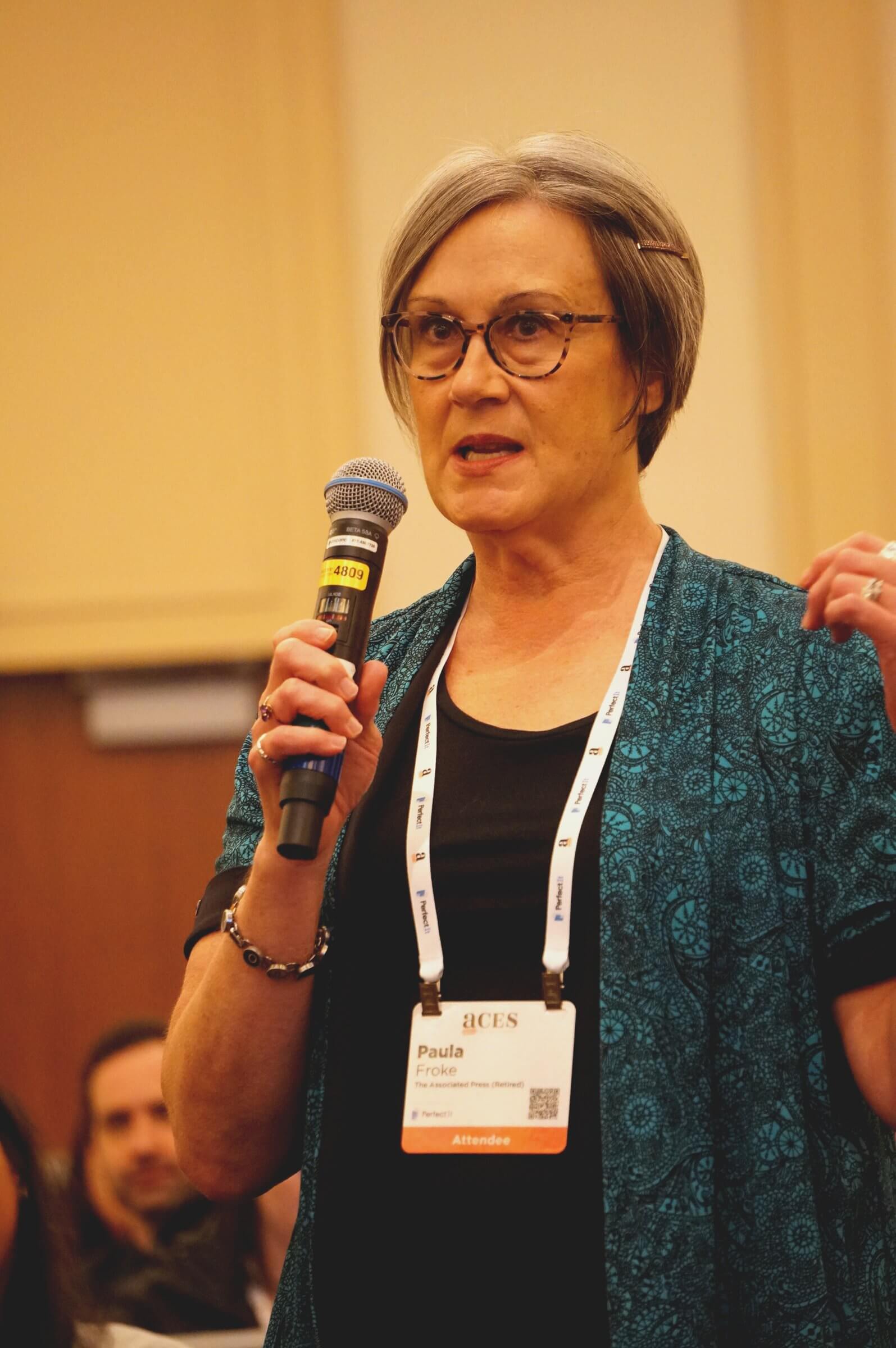
They got an assist from the audience from former AP Stylebook Editor Paula Froke, who retired earlier this year. (Later that evening, at its annual Awards Banquet, ACES named her as the recipient of the 2025 Glamann Award.)
Staffing changes at the AP Stylebook
The ongoing transition from Froke to a new stylebook editor was a big reason why the ACES crowd didn’t get its usual rundown of style changes made this year or coming soon to a spiral-bound book near you.
Barrett said the search for a new editor is going well and the AP hopes to have someone in Froke’s former position soon.
“I’m looking forward to it because we are kind of underwater,” said Barrett, who added that the AP is looking for a new standards editor as well.
There’s a lot going on, she said. “As we’re all exploring AI, there are standards issues there.”
The standards team and the stylebook team often work together, with the standards team focusing on journalism practices.
Broadening the Stylebook’s scope
Bratton, who is a member of the stylebook team, said the stylebook committee discussions have evolved a lot over the years, and changed under Froke’s tenure more from nerdy, technical talk on issues like hyphens and capitalization to broader discussions on language and usage in context.
Changes in recent years that Froke spearheaded included expanded guidance on race-related terms and coverage, gender-neutral language, identity, and a focus on topic guidance.
At the 2024 ACES conference, Froke announced additions on climate change as part of the topic guidance approach.
At the time, she said: “Not so long ago, the stylebook’s scope was more limited to grammar, spelling and punctuation, but we believe there’s a need to help tell accurate, complete stories on these nuanced issues.”
Bratton said that in the next year, the stylebook committee will be working on the immigration entry. One thing they have to consider is what in the current stylebook is still applicable.
“As editors we want things to stay the same, but they can’t,” Bratton said.
Another focus will be on entries involving criminal justice issues, especially around juvenile crime.
What’s in a name?
The discussion did include two recent changes.
“You may have heard we did something on the Gulf of Mexico,” Bratton said, to appreciative laughter.
Bratton said that decision to retain the name Gulf of Mexico was spurred by the AP’s newsrooms, where reporters were asking for guidance on President Trump’s announcement that he had changed the body of water’s name to the Gulf of America.
The new entry in the AP Stylebook is now titled “Gulf of Mexico, Gulf of America” and the guidance is to refer to it by its original name while acknowledging the new name Trump has chosen.
“It took several weeks. We had to have a lot of conversations and asked for input because it doesn’t just involve our country,” Bratton said noting that the AP audience is worldwide.
“It’s been named that for more than 400 years and it’s not just in the purview of the United States. There are other countries involved.”
Bratton contrasted that with the decision to change the name of Denali back to Mount McKinley.
“The area lies solely in the United States and, as president, Trump has the authority to change federal geographical names within the country,” Bratton said.
She also noted that the named had been changed from McKinley to Denali fairly recently by President Obama.
“We decided the president can just change the name. So now we call it McKinley again,” Barrett said. “It was rooted in logic, there were a lot of discussion, and it makes sense.”
Both resolutions exemplify the way the AP Stylebook team always makes decisions, Barrett said — with a lot of discussion and a lot of people — with expertise in the subject as well as language — in the room.
“It was logical and simple,” Barrett added.
Nerding out with AP
Questions from the audience turned to entries that some editors would like to see the AP change. For instance, making health care one word.
“We were actually talking about that last night at our nerdy word dinner, and maybe we’ll revisit it,” Bratton said.
Another topic that came up was the Oxford comma.
“I always go back to us being a wire service and we want to use fewer characters,” Bratton said about the AP guidance to skip the Oxford comma if the sentence makes sense without it.
The AP team made no promises one way or the other about that little, often debated comma.
Barrett noted that the needs of the AP newsrooms still have a large role in the decisions the AP Stylebook team makes, despite all the people outside of the AP who use the book.
“Because it’s our internal style, that’s probably the first thing we think about,” Bratton said. “We try to be clear that you won’t be shot if you use a different version” of a style rule.
Ask the Editor?
With Froke stepping down, many people wanted to know what’s going to happen to the Ask the Editor feature of the online AP Stylebook.
From the audience, Froke said she expects it to return. She also couldn’t name her favorite Ask the Editor entry, as there were so many over the years.
It seems much will await the new editor.
An audience member asked why the AP didn’t save about three pages in the stylebook by just saying numerals should always be figures.
Froke reminded everyone that at a past ACES conference, she hosted a 90-minute session to talk about how to fix the numerals entries. A consensus wasn’t reached.
“The idea is we can’t fix it without breaking something else,” Froke said. “We kind of came down at the end of that with a 50-50 vibe.”
She said when she became stylebook editor, one of her big goals was to fix the numerals entry.
“And it’s just not possible,” she said. “Well, maybe it’s possible, and the next editor will fix it.”
Longtime ACES member Gerri Berendzen is a lecturer at the William Allen White School of Journalism and Mass Communications at the University of Kansas. She spent 30 years working on copy desks at news organizations before that and today specializes in teaching editing, writing, and information management. She is currently a member of the ACES Communications and Publications Committee.
ACES: The Society for Editing
ACES: The Society for Editing is the nation’s leading organization of editing professionals, educators, and students. Founded in 1997 by copy editors, ACES is dedicated to improving the quality of the written word and the working lives of editors. It sets standards of excellence and gives a voice to editors in journalism, government, business, publishing, and beyond through top-notch training, networking, and career opportunities. ACES hosts an annual in-person conference and, since 2022, an annual virtual conference. ACES Academy hosts monthly webinars. ACES also offers certificates in editing, which it co-hosts with The Poynter Institute, a global leader in journalism.